Molecular junctions
Since it was discovered that conjugated oligomers and polymers could serve as active components in functional electronic devices, global research
in emerging moletronics-based technologies has flourished into a tremendously interdisciplinary field, producing significant advancements. These
breakthroughs allow us to envision and design innovative nanoscale devices with a variety of functions. However, the success of these technologies
depends on our ability to intentionally design and adjust the electronic properties of junctions. Achieving precise tuning of molecule-junction
properties involves synthesizing molecules with specific functionalities and designing appropriate molecule-electrode contacts through specific
anchoring groups. To isolate the effects of the three components present on most junctions, molecule, anchoring group, and electrode, systematic
studies are needed, focusing on keeping two components constant while varying the third.
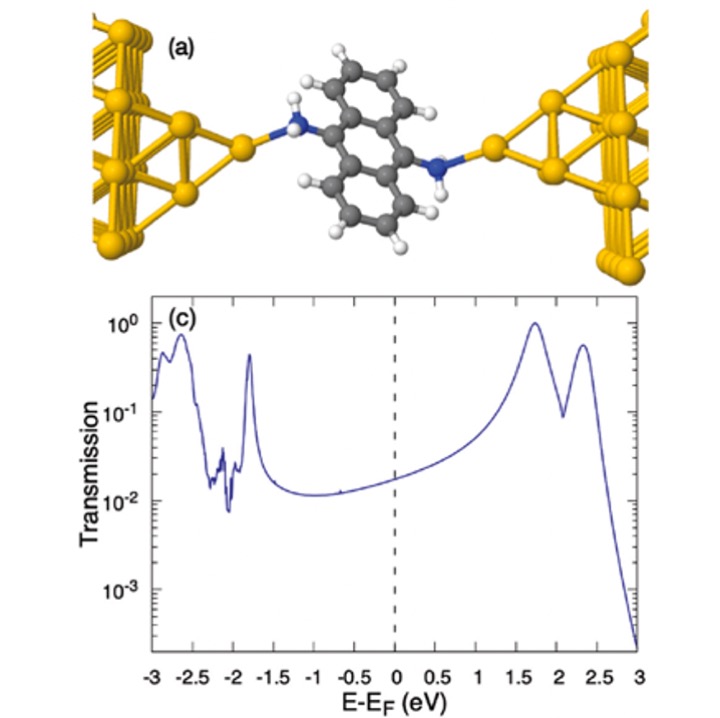
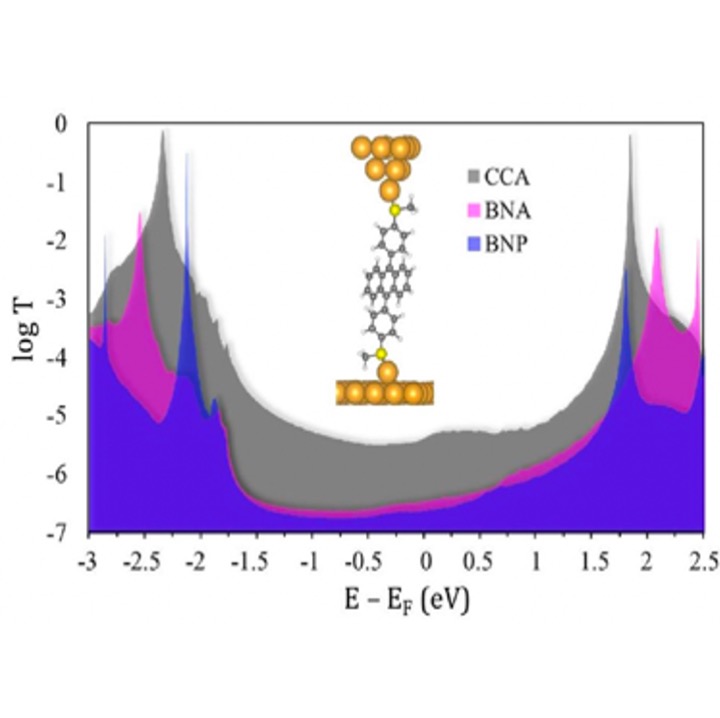
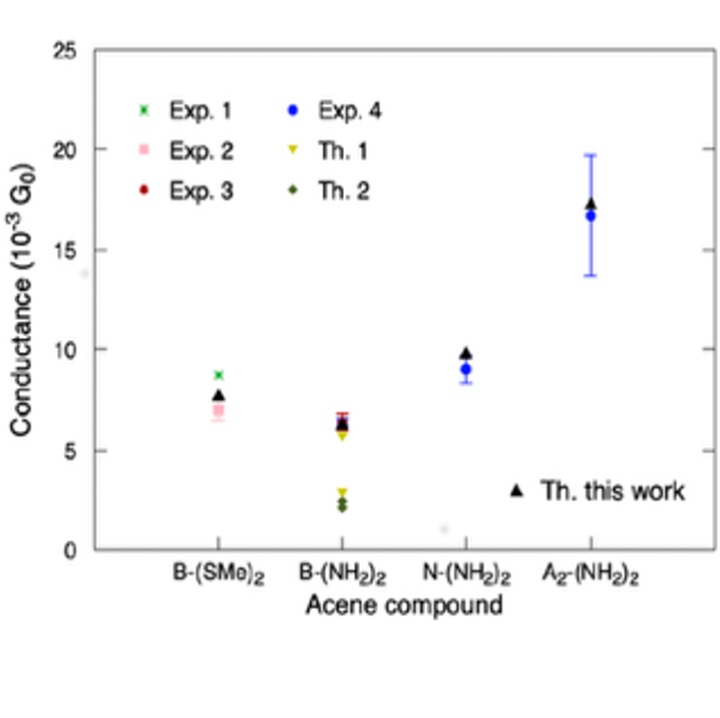
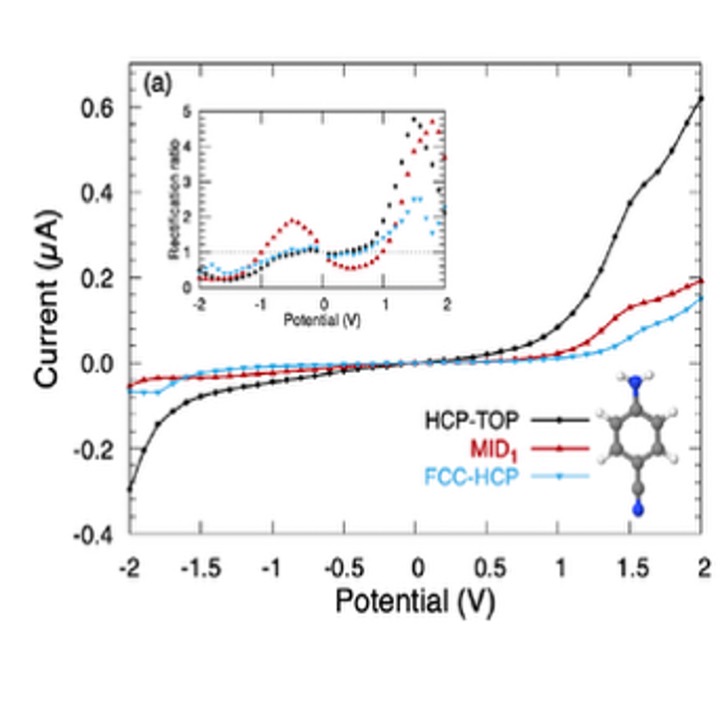
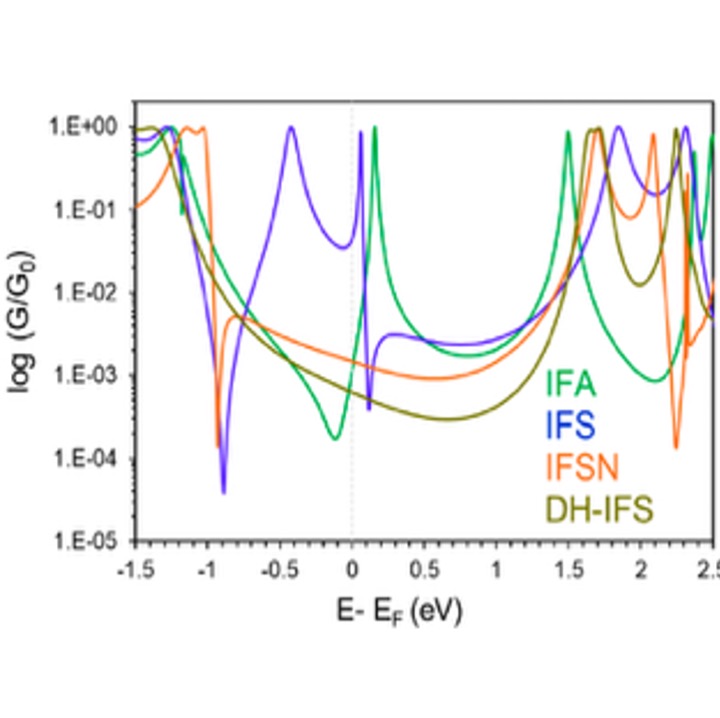
Our objective in this area is to carry out systematic research that accurately describes conductivity in electrode-molecule-electrode systems and
to suggest alterations that may enhance system conductivity. Additionally, we aim to develop models capable of making conductivity predictions using
minimal computational resources, assisting experimental groups in directing their work towards the most promising systems.
Related publications
6. Single-Molecule Conductance of Neutral Closed-Shell and Open-Shell Diradical Indenofluorenesi.
Raquel Casares, Sandra Rodríguez-González, Álvaro Martínez-Pinel, Irene R. Márquez, M. Teresa González, Cristina Díaz , Fernando Martín, Juan M. Cuerva, Edmund Leary, Alba Millán.
Journal of the American Chemical Society, 146 29977 (2024).
5. Tailoring single-molecule conductance with structured graphene electrodes.
Joel G. Fallaque, Sandra Rodríguez-González, Cristina Díaz , Fernando Martín.
Applied Surface Science 646 158943 (2024).
4. Self-energy corrected DFT-NEGF for conductance in molecular junctions: an accurate and efficient implementation for TRANSIESTA package applied to Au electrodes.
Joel G Fallaque, Sandra Rodríguez-González, Fernando Martín, C. Díaz .
Journal of Physics: Condensed Matter, 34 435901 (2022).
3. Engineering the HOMO-LUMO gap of indeno[1,2-b]fluorene.
Raquel Casares, &Aaute;lvaro Martínez-Pinel, Sandra Rodríguez-González, Irene R. Márquez, Luis Lezama, M. Teresa González, Edmund Leary, Víctor Blanco, Joel G. Fallaque, C. Díaz Fernando Martín, Juan M. Cuerva, Alba Millán.
Journal of Materials Chemistry C, 10 11775 (2022).
2. A simple model to engineer single-molecule conductance of acenes by chemical disubstitution.
Joel G. Fallaque, Sandra Rodr$iacute;guez-González, Cristina Díaz , Fernando Martín.
Nanoscale 14 464 (2022).
1. Single-Molecule Conductance of 1,4-Azaborine Derivatives as Model of BN-doped PAHs.
L. Palomino-Ruiz, S. Rodríguez-González, J. G. Fallaque, I. R. Márquez, N. Agrait, C. Díaz , E. Leary, J. M. Cuerva, A. G. Campaña, F. Martín, A. Millán, M. T. González.
Angewandte Chemie International Edition 60 6609 (2021).