Dynamics at surfaces
Surface chemistry plays a crucial role in our daily lives, influencing various applications such as heterogeneous catalysis, semiconductor-based technologies,
medical technology, anticorrosive solutions, and lubricants. It's interesting to note that the majority of chemical production processes used worldwide rely on
heterogeneous catalysts.
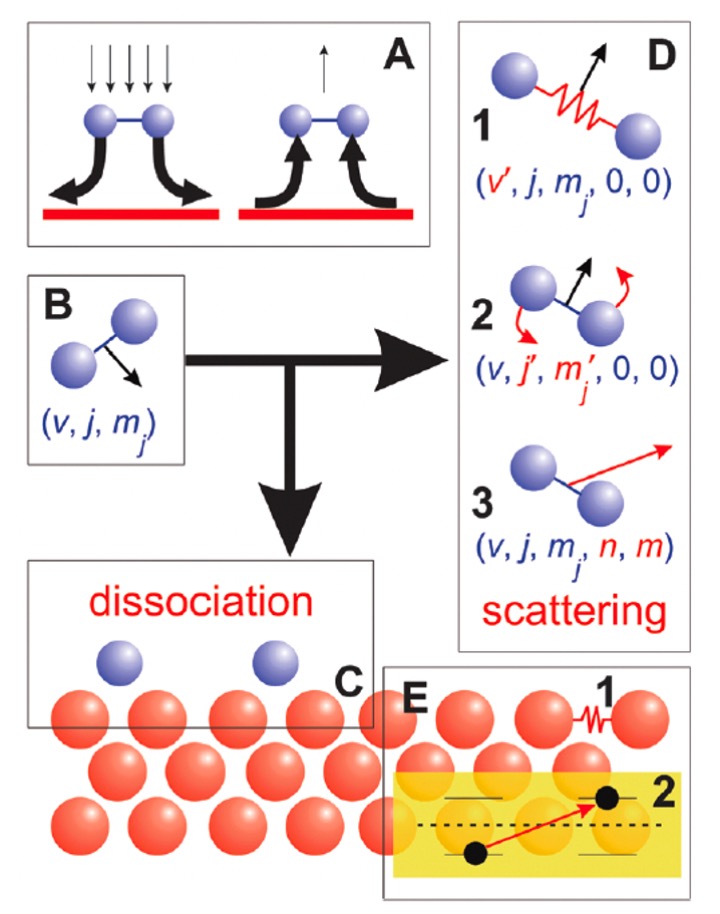
We can describe heterogeneously catalyzed processes by breaking them down into basic reactions, such as dissociative chemisorption, where a molecule collides with
a surface, causing a bond in the molecule to break and the formation of two new bonds between the resulting fragments and the surface. The field of molecule-surface
reaction dynamics aims to predict how these and other fundamental reactions behave, as well as alternative processes that include vibrationally elastic scattering,
rotationally inelastic scattering, and diffractive scattering. Like dissociative chemisorption, these processes may involve energy transfer through surface phonons
and, in the case of metallic surfaces, electron-hole pair (ehp) excitation. While the primary goal in surface reaction kinetics is to calculate reaction rates, in
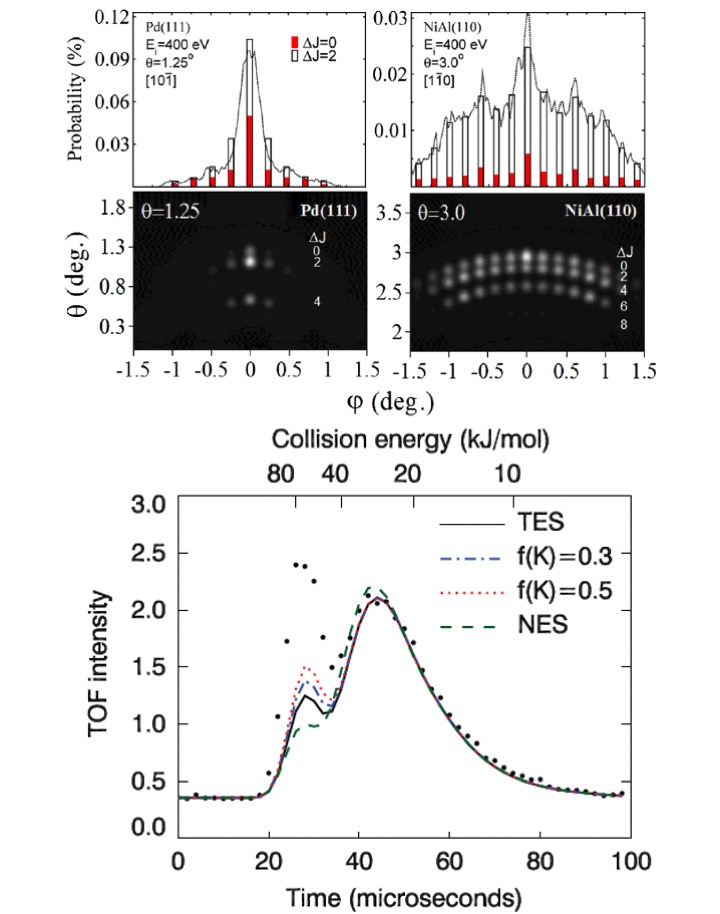
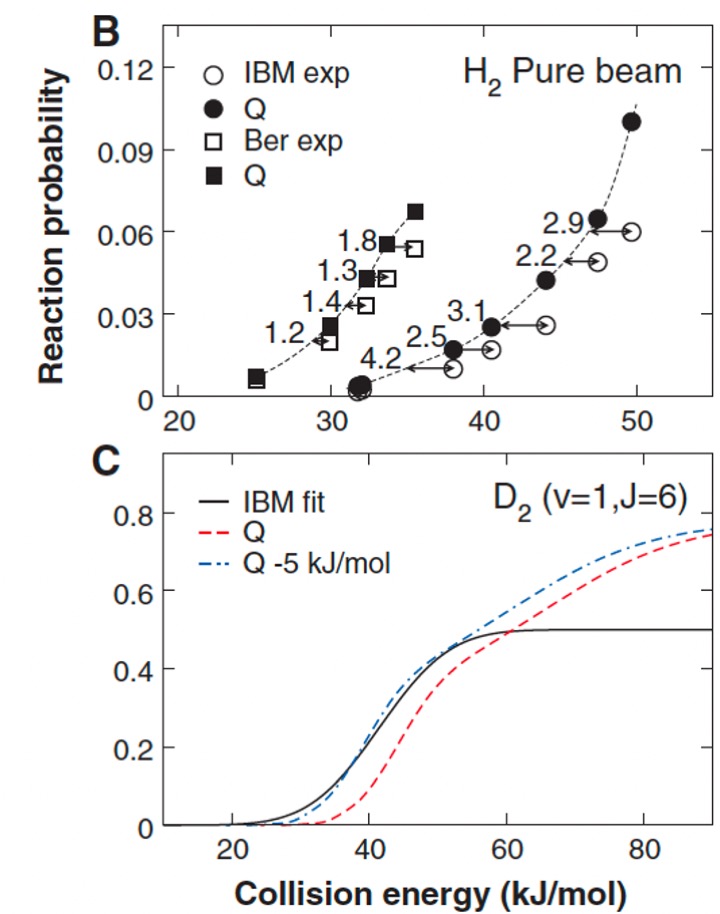
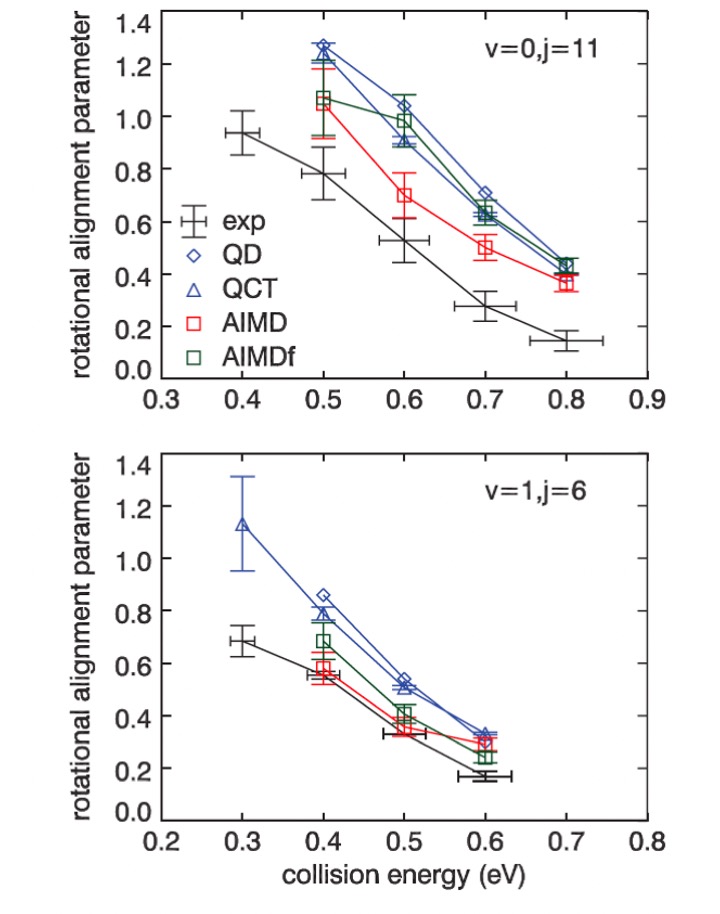
the study of dynamics, the objective is generally to determine the probabilities of reaction or scattering as a function of incidence energy. More detailed information
may also be sought, such as the dependence of a process on incidence angle, initial quantum state, and surface temperature.
Related publications
57. Benchmarking DFT functionals for Argon adsorption on Ru(0001): assessment of van der Waals corrections for gassurface interactions.
Carmen A. Tachino, Cristina Díaz.
Journal of Physics: Condensed Matter, 38 015003 (2026).
56. Semiquantum versus quantum methods for grazing-incidence fast-atom diffraction: Influence of the wave-packet size.
A. S. Muzas, L. Frisco, G. A. Bocan, C. Díaz M. S. Gravielle.
Physical Review A 109 042823 (2024).
55. Stereodynamics effects in grazing-incidence fast-molecule diffraction.
Marcos del Cueto, Alberto S. Muzas, Fernando Martín, C. Díaz.
Physical Chemistry Chemical Physics 24 19541 (2022).
54. Grazing incidence fast atom and molecule diffraction: theoretical challenges.
Cristina Díaz , María Silvia Gravielle.
Physical Chemistry Chemical Physics 24 15628. (2022)
53. Normal and off-normal incidence dissociative dynamics of O2(v,J) on ultrathin Cu films grown on Ru(0001).
J. G. Fallaque, M. Ramos, H. F. Busnengo, F. Martín, C. Díaz.
Physical Chemistry Chemical Physics 23 7768 (2021).
52. Accurate simulations of atomic diffractive scattering from KCl(001) under fast grazing incidence conditons.
M. del Cueto, A. S. Muzas, F. Martín, C. Díaz .
Nuclear Instruments and Methods in Physics Research B 476 1 (2020).
51. Prominent out-of-plane diffracton in helium scattering from a methyl-terminated Si(111) surface.
M. del Cueto, A. S. Muzas, T. J. Frankcombe, F. Martín, C. Díaz.
Physical Chemistry Chemical Physics 21 15879 (2019).
50. Quantum Stereodynamics of Hu2 Scattering from Co(0001): Influence of Reaction Channels.
M. del Cueto, X. Zhou, A. S. Muzas, C. Díaz , F. Martín, B. Jiang, H. Guo.
Journal of Physical Chemistry C 123 16223 (2019).
49. Performance of van der Waals DFT approaches for helium diffraction on metal surfaces.
M. del Cueto, M. J. Reinhard, A. Al Taleb, D. Farías, F. Martín, C. Díaz .
Journal of Physics: Condensed Matter 31 135901 (2019).
48. Non-adiabatic Scattering of NO off Au3 Clusters: A simple and robust diabatic state manifold generation method for multiconfigurational.
C. Robertson, J. González-Vázquez, S. Díaz-Tendero, I. Corral, and C. Díaz .
Journal of Computational Chemistry 40 794 (2019).
47. Thickness-Dependent Reactivity of O2 on Cu Layers Grown on Ru(0001) Surfaces.
M. Ramos, C. Díaz , A. E. Martínez, F. Martín and H. F. Busnengo.
Journal of Physical Chemistry C 122 15529 (2018).
46. H2/LiF(001) diffractive scattering under fast grazing incidence using a DFT-based potential energy surface.
A. S. Muzas, M. del Cueto, F. Gatti, M. F. Somers, G. J. Kroes, F. Martín and C. Díaz.
Physical Review B 96 205432 (2017).
45. Exploring surface landscapes with molecules: rotationally induced diffraction of H2 on LiF(001) under fast grazing incidence conditions.
M. del Cueto, A. S. Muzas, M. F. Somers, G. J. Kroes, C. Díaz and F. Martín.
Physical Chemistry Chemical Physics 19 16317 (2017).
44. Dissociative and non dissociatice adsorption of O2 on Cu(111) and CuML surfaces: adiabaticy takes over.
M. Ramos, C. Díaz , A. E. Martínez, H. F. Busnengo and F. Martín.
Physical Chemistry Chemical Physics 19 10217 (2017).
43. Enigmatic HCl+Au(111) reaction: A puzzle for theory and experiment.
G. Fuchsel, M. del Cueto, C. Díaz and G. J. Kroes.
Journal of Chemical Physics C, 120 25760 (2016).
42. Experimental and theoretical study of rotationallu inelastic diffraction of H2(D2) from methyl-terminates Si(111).
K. J. Nihill, Z. M. Hund, A. S. Muzas, C. Díaz , M. del Cueto, T. Frankcombe, N. T. Plymale, N. S. Lewis, F. Martín, and S. J. Sibener.
Journal of Physical Chemistry, 145 084705 (2016).
41. Diffraction of H from LiF(001): From slow normal incidence to fast grazing incidence.
A. S. Muzas, F. Gatti, F. Martín, C. Díaz .
Nuclear Instruments and Methods in Physics Research B, 382 49 (2016).
40. Quantum and classical dynamics of reactive scattering of H2 from metal surfaces.
G. J. Kroes, C. Díaz .
Chemical Society Review, 45 3658 (2016).
39. The role of the initial ro-vibrational state in molecule/surface scattering under fast grazing incidence.
A. S. Muzas, F. Martín, C. Díaz .
Journal of Physics: Conference series 635 012029 (2015).
38. Scattering of H(D) from LiF(100) under fast grazing incidence conditions: To what extent is classical dynamics a useful tool?.
A. S. Muzas, F. Martín, C. Díaz.
Nuclear Instruments and Methods in Physics Research B, 354 9 (2015).
37. Dissociation and recombination of D2 on Cu(111): Ab initio Molecular Dynamics Calculations and Improved Analysis of Desorption Experiments.
F. Nattino, A. Genova, M. Guijt, A. S. Muzas, C. Díaz , D. J. Auerbach and G. J. Kroes.
Journal of Chemical Physics, 141 124705 (2014).
36. Elementary Molecule-Surface Scattering Processes Relevant to Heterogenerous Catalysis: Insights from Quantum Dynamics Calculations.
C. Díaz, A. Gross, B. Jackson and G. J. Kroes.
Molecular Quantum Dynamics: From Theory to Applications. Springer, Physical Chemistry in Action
Sciences (2013) ISBN 978-3-642-45289-5.
35. Environment-driven reactivity of H2 on PdRu surface alloys.
M. Ramos, M. Minniti, C. Díaz, D. Farías, R. Miranda, F. Martín, A. E. Martínez and H. F. Busnengo.
Physical Chemistry Chemical Physics, 15 14936 (2013).
34. Thermal Lattice Expansion Effect on Reactive Scattering of H2 from Cu(111) at Ts=925 K.
A. Mondal, M. Wijzenbroek, M. Bonfanti, C. Díaz and G. J. Kroes.
Journal of Physical Chemistry A, 117 8770 (2013).
33. 7D Quantum Dynamics of H2 scattering from Cu(111): the accuracy of the phonon sudden approximation.
M. Bonfanti, M. F. Somers, C. Díaz, H. F. Busnengo and G.-J. Kroes.
Zeitschrift fur physikalische Chemie, 2271397 (2013).
32. Using Molecular Reflectivity to Explore Reaction Dynamics at Metal Surfaces.
C. Díaz and F. Martín.
Dynamics of Gas-Surface Interaction: Atomic-Level Undertanding of Scaattering Processes at Surfaces. Springer Series in Surface Sciences (2013) ISBN 978-3-642-32954-8/ISBN 978-3-642-32955-5.
31. Vibrational deexcitation and rotational excitation of H2 and D2 scattered from Cu(111): Adiabatic versus non-adiabatic dynamics.
A. S. Muzas, J. I. Juaristi, M. Alducin, E. Díez-Muiño, G. J. Kroes and C. Díaz.
Journal Chemical Physics, 137 064707 (2012).
30. Helium, neon and argon diffraction from Ru(0001).
M. Minniti, C. Díaz, J. L. Feirnández Cuñado, A. Politano, D. Maccariello, F. Martín, D. Farías and R. Miranda.
Journal of Physics: Condensed Matter, 24 354002 (2012).
29. H2 diffraction from a strained pseudomorphic monolayer of Cu deposited on Ru(0001).
C. Díaz, F. Martín, G. J. Kroes, M. Minniti, D. Farías and R. Miranda.
Journal Physical Chemistry C, 116 13671 (2012).
28. Effect of surface motion on the rotational quadrupole alignment parameter on D2 reacting on Cu(111).
F. Nattino, C. Díaz, B. Jackson and G. J. Kroes.
Physical Review Letters, 108 236104 (2012).
27. Dynamics of H2 dissociation on the 1/2 ML c(2x2)-Ti/Al(100) surface.
J.-C. Chen, M. Ramos, C. Arasa, J. C. Juanes-Marcos, M. F. Somers, A. E. Martínez C. Díaz, R. A. Olsen and G. J. Kroes.
Physical Chemistry Chemical Physics, 14 3234 (2012).
26. Six-dimensional quasiclassical and quantum dynamics of H2 dissociation on the c(2x2)-Ti/Al(100) surface.
J. C. Chen, J. C. Juanes-Marcos, S. Woittequand, M. F. Somers, C. Díaz, R. A. Olsen and G. J. Kroes.
Journal of Chemical Physics, 134 114708 (2011).
25. Hydrogen dissociation on Cu(111): the influence of lattice motion I.
M. Bonfanti, C. Díaz, M. F. Somers and G. J. Kroes.
Physical Chemistry Chemical Physics, 13 4552 (2011).
24. Apparent failure of the Born-Oppenheimer static surface model for vibrational excitation of molecular hydrogen on copper.
G. J. Kroes, C. Díaz, E. Pijper, R. A Olsen and D. J. Auerbach.
Proceedings of the National Academy of Science, 107 20881 (2010).
23. Experimental and Theoretical Study of Rotationally Inelastic Diffraction of D2 from NiAl(110).
G. Laurent, D. Barredo, D. Farías, R. Miranda, C. Díaz, P. Rivière, M. F. Somers and F. Martín.
Physical Chemistry Chemical Physics 12 14501 (2010).
22. Grazing incidence scattering of vibrationally excited H2 molecules from metal surfaces.
D. Stradi, C. Díaz and F. Martín.
Surface Science 604 2031 (2010).
21. Reactive scattering of H2 from metal surfaces under fast grazing incidence conditions.
C. Díaz and F. Martíni.
Physical Review A 82 012901 (2010).
20. Dynamics on six-dimensional potential energy surface for H2/Cu(111): Corrugation reducing procedure versus modified Shepard interpolation method and PW91 versus RPBE.
C. Díaz, R. A. Olsen, H. F. Busnengo and G. J. Kroesi.
Journal of Physical Chemistry C 114 11192 (2010).
19. Six-dimensional dynamics study of reactive and non reactive scattering of H2 from Cu(111) using a chemically accurate potential energy surface.
C. Díaz, R. A. Olsen, D. J. Auerbach and G. J. Kroes.
Physical Chemistry Chemical Physics 12 6499 (2010).
18. Nonmonotonic dissociative adsorption of vibrationally excited H2 on metal surfaces.
G. Laurent, C. Díaz, H. F. Busnengo and F. Martín.
Physical Review B 81 161404 (2010).
17. Dynamics of dissociative adsorption of hydrogen on a CO-precovered Ru(0001) surface: a comparison of theoretical and experimental results.
I. M. N. Groot, J. C. Juanes-Marcos, C. Díaz, M. F. Somers, R. A. Olsen and G. J. Kroes.
Physical Chemistry Chemical Physics 12 1331 (2010).
16. A note on the vibrational efficacy in molecule-surface reactions.
C. Díaz, and R. A. Olsen.
Journal of Chemical Physics 130 094706 (2009).
15. Chemically accurate simulation of a prototypical surfaces reaction: H2 Dissociation on Cu(111).
C. Díaz, E. Pijper, R. A. Olsen, H. F. Busnengo, D. J. Auerbach and G. J. Kroes.
Science 326 832 (2009).
14. Molecular effects in H2 scattering from metal surfaces at grazing incidence.
C. Díaz, P. Rivière and F. Martín.
Physical Review Letters 103 013201 (2009).
13. Molecular effects in grazing incidence collisions of H2 with metal surfaces.
C. Díaz, P. Rivière and F. Martín.
Journal of Physics: Conference Series 194 012058 (2009).
12. Associative desorption of N2 from Ru(0001): A computational study.
C. Díaz, A. Perrier and G. J. Kroes.
Chemical Physics Letters 434 231 (2007).
11. Dynamics of H2 chemisorption on metal surfaces.
H. F. Busnengo, C. Díaz, P. Riviere, M. A. Di Cesare, F. Martín, W. Dong and A. Salin.
Photonic, Electronic and Atomic Collisions 625 (2006).
10. Rective and non reactive scattering of N2 from Ru(0001): A six-dimensional adiabatic study.
C. Díaz, J. K. Vincent, G. P. Krishnamohan, R. A. Olsen, G. J. Kroes, K. Honkala and J. K. Norskov.
Journal of Chemical Physics 125 114706 (2006).
9. Multidimensional effects on dissociation of N2 on Ru(0001).
C. Díaz, J. K. Vincent, G. P. Krishnamohan, R. A. Olsen, G. J. Kroes, K. Honkala and J. K. Norskov.
Physical Review Letters 96 096102 (2006).
8. Experimental Evidence of Dynamic Trapping in the Scattering of H2 from Pd(110).
D. Barredo, G. Laurent, C. Díaz, P. Nieto, H. F. Busnengo, A. Salin, D. Farias andF. Martín.
Journal of Chemical Physics 125 051101 (2006).
7. Quantum and classical dynamics of H2 scattering from Pd(111) at off-normal incidence.
C. Díaz, M. F. Somers, G. J. Kroes, H. F. Busnengo, A. Salin and F. Martín.
Physical Review B 72 035401 (2005).
6. A classical dynamics method for H2 diffraction from metal surfaces.
C. Díaz, H. F. Busnengo, P. Riviere, D. Farías, P. Nieto, M. F. Somers, G. J. Kroes, A. Salin and F. Martín.
Journal of Chemical Physics 122 154706 (2005).
5. In-plane and Out-of-Plane Diffraction of H2 from Metal Surfaces.
D. Farías, C. Díaz, P. Riviere, H.F. Busnengo, P. Nieto, M.F. Somers, G.J. Kroes, A. Salin and F. Martín.
Physical Review Letters 93 246104 (2004).
4. Theoretical and experimental study of the scattering of H2 from a Pd(111) surface.
C. Díaz, H.F. Busnengo, P, Riviere F. Martín, A. Salin, P. Nieto, and F. Farías.
Physica Scripta T110 394 (2004).
3. Pronounced out-of-plane diffraction of H2 from Pd(111).
D. Farías, C. Díaz, P. Nieto, A. Salin and F. Martín.
Chemical Physical Letters 390 250 (2004).
2. Theoretical analysis of the relation between H2 dissociation and reflection on Pd surfaces.
C. Díaz, F. Martín, H. F. Busnengo and A. Salin.
Journal of Chemical Physics 120 321 (2004).
1. Angular distribution of H2 molecules scattered from del Pd(111) surface.
C. Díaz, H.F. Busnengo, F. Martín, A. Salin.
Journal of Chemical Physics 118 2886 (2003).